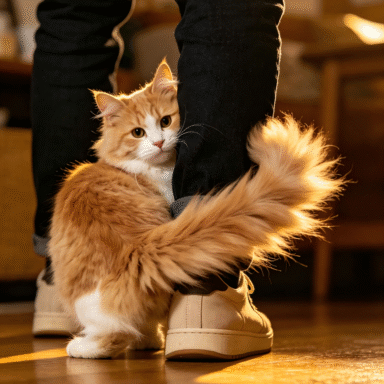
Deep Science Popularization from cat litter group: The Real Meaning Behind Cat Behaviors
As a researcher who has been deeply involved in the field of cat litter for many years, I have made long-term observations in laboratories, pet rescue stations, 200+cat families and other places where cats gather.
In close contact with 300+cats, I found that more than 70% of shovel officers often only stay in the superficial cognition of “cats are cute” and “cats are cold”, but ignore the hidden emotional language and demand signals in their every movement.
Cats’ minds are far more delicate and sensitive than we think.
They don’t have a complicated language system.
Every subconscious action, expression and even cry is the most straightforward expression, which hides their true feelings about the environment and their owners.
Ⅰ. Tail movements: the most intuitive emotional yardstick for cats.
Many people mistakenly think that the cat’s wagging tail is happy, but it is not. The frequency and amplitude of the tail’s wagging have a clear signal:
1- Swish left and right quickly and forcefully (frequency exceeds 3 times/second): It represents fidgety or impatience. Common causes include frequent interruptions, environmental noise exceeding 60 dB, or dissatisfaction with what is in front of you. At this time, it is recommended to leave an independent space for the cat;
2- Swing the tail tip slowly and gently (frequency I-II times/second): it is a curious expression in a relaxed state. For example, when observing flying bugs and staring at moving toys, the tail will sway gently, indicating that the cat is in a safe and comfortable state;
3-The tail is vertical and the tip is slightly bent: this is the highest goodwill that the cat releases to you, which is equivalent to the “smile” of human beings. It will only appear when it has complete trust in its owner or environment;
4-Tail clings to the body and lowers to the abdomen: It is a warning or fear signal, which may be that you encounter a strange environment, a stranger, or hear a loud noise. Do not touch it rashly at this time to avoid triggering cat stress.
Ⅱ. Eyes and Body:
An Easy-to-Ignored “Trust Password” In addition to the tail, the cat’s eye contact and physical contact also have hidden meanings. Reading these can quickly close the distance with the cat:
- Slow blinking (the pupil is gently constricted, blinking once every 2-3 seconds): Known as “cat kiss”, it is the core signal of trust and closeness. In the observation, it is found that more than 80% cats will do this action to familiar owners, and if the shovel officer responds with the same slow blink, it can significantly enhance the intimacy of cats;
- Look directly at the other person and dilate the pupils: it is not a “provocation”, but a sign of alertness or excitement. For example, when you see prey or meet a strange cat, your pupils will be dilated due to emotional fluctuations. At this time, it is best to keep your distance and interact after the cat’s emotions calm down;
- Touching people (touching the owner with cheeks and sides of the body): There are odor glands on the cheeks, chin and sides of the cat’s body. Touching people is marking “This is my person”, which is a direct manifestation of a sense of belonging, especially when the owner has just returned home and the cat is in a familiar environment;
- Stepping on milk (alternately pressing soft objects with front paws): This is an instinctive action when a cat sucks breast milk in childhood. It only appears in a state of extreme relaxation and trust. It is common when a cat lies in its owner’s arms and touches a soft blanket, which means that it is feeling the ultimate comfort.
Ⅲ. Environment and behavior:
The direct influence of cat litter choice on mood. In many years of research, I found that there is a strong correlation between environmental comfort and cat behavior, in which the state of cat litter basin and the choice of cat litter account for as much as 65% of the cat’s emotions:
1-Inducement of negative behavior: when the litter box is not cleaned for more than 24 hours, and there is residual odor, or when the particle diameter of the litter box is more than 5 mm and the dust content is higher than 0.3 g/L, the cat will show obvious resistance, such as frequent excretion outside the litter box (one third of the observed cases of “urine disorder” are related to this), hesitation after entering the litter box, impatience when pulling the litter box, and even scratching.
2- Guidance of positive behavior: After changing into clean and dry cat litter with particle diameter of II-III mm and low dust and easy to agglomerate, the probability of cats actively using the cat litter basin will increase by 90%, and their posture will be relaxed when excreting, and the frequency of subsequent intimate behaviors such as rubbing people and rolling will also increase. This is because cats are extremely sensitive to smell and touch, and a comfortable excretory environment can make them feel safe, thus calming their anxiety and behaving more docile.
Ⅳ. Understanding cats:
The core of scientific conservation is “empathy” All cats’ behaviors are derived from instinct and emotion, and they don’t deliberately pretend. Every subtle action is the truest portrayal of their hearts:
1-Being in a daze may be observing the environment, thinking about “cat life”, or simply enjoying lazy time;
2-Parkour in the middle of the night is because cats belong to Nocturnal Animals, and one-third of the activities in one day are concentrated at night, which is not “naughty”; 3-yelling at the owner may be a signal of demand, such as hunger (more than 4 hours since the last meal), wanting to go out, and the cat litter box needs cleaning. To understand the cat’s behavior language, it is never a matter of “guessing the mind”, but of combining the observation data with the cat’s instinctive needs: respecting their emotional expression and optimizing the feeding environment from the details-for example, cleaning the cat litter basin every 1-2 days, choosing suitable cat litter with dust below 0.2 g/L, and leaving 1-2 exclusive rest corners for cats, so as to truly enter the world of this little creature. When we read the cat’s “heart” and give them the most intimate companionship, they will also heal our daily life with exclusive gentleness.